



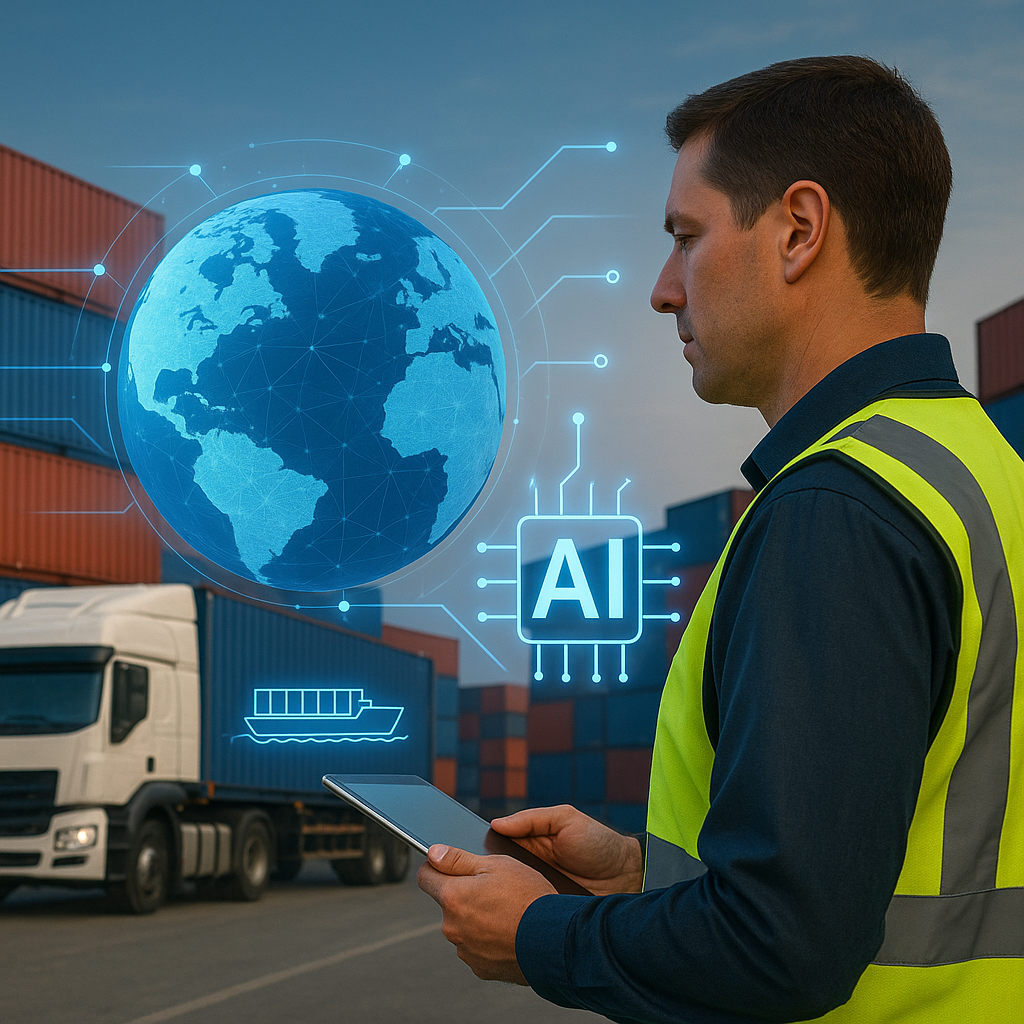
As the world of beverage logistics grows more complex, Artificial Intelligence (AI) is becoming an essential partner in moving wine, spirits, and soft drinks efficiently and compliantly. From automated documentation and customs checks to smarter route planning and carbon tracking, AI is helping ensure product quality, maintain temperature integrity, and improve visibility across every stage of the shipping journey.
In global logistics operations, AI can transform workflows, particularly in areas such as customs, scheduling and compliance. It enhances both speed and efficiency while reducing the risk of error. Yet, as with any technological shift, these opportunities must be balanced with care and the continued need for human expertise and oversight.
AI may be changing how goods move, but people remain at the centre
Technology alone cannot replace human experience and adaptability. Let’s take a closer look at how AI is reshaping logistics, where it delivers the greatest benefits, and why human insight remains essential.
There are different types of AI, not just one single technology, but an umbrella term covering several approaches. Each type has its place in forwarding, and its value grows when applied in combination.
- Traditional AI – There is rules-based automation, which is ideal for repetitive processes such as document handling or compliance checks.
- Predictive AI – Analyses historical and real-time data to forecast outcomes such as port congestion, demand shifts, or freight rate fluctuations.*
- Conversational AI – Chatbots and digital assistants providing real-time shipment updates, proactive exception handling, or instant quotes. In the automotive industry, it allows drivers to interact with car infotainment and navigation systems using voice assistants. In business automation, it handles data entry or invoice processing with minimal human intervention.
- Generative AI – A subset of AI and a more sophisticated form of machine learning, able to create content such as customised reports or even simulations of cargo flows.
Driving Efficiency Across the Supply Chain
- Automating Repetitive Tasks – logistics is a document-heavy sector. Bills of lading, invoices, and customs forms require precision and consume a significant staff time. AI can extract, validate, and pre-populate data across these documents, freeing employees to focus on strategic and client-facing work.
- Predicting and Planning Smarter in Ports – Machine learning models can analyse real-time port data, weather patterns, and industrial events. As a result, they can forecast the spikes in demand, shipping delays. This foresight allows forwarders to plan contingency routes and avoid costly disruptions.
- Measuring Carbon and ESG Performance – Sustainability reporting is becoming a regulatory and commercial imperative. AI can track emissions across routes and transport modes with far greater accuracy, helping forwarders and shippers make greener choices and credibly report against ESG frameworks.**
- Scaling Without Growing Costs – AI systems can manage surging shipment volumes without proportional increases in staff. This scalability provides forwarders with a competitive edge in fast-paced global markets.
In Customs, AI Helps but Humans Must Lead
Customs clearance is one of the most prominent applications for AI in forwarding. Standard declarations can be pre-populated by extracting invoice data and mapping HS codes, reducing human workload and error rates.
However, excise goods are more complex – duty rates vary by product strength, volume or exemptions. Misclassification can lead to big penalties and joint liability. AI can highlight likely classifications and flag anomalies, but human oversight remains essential. Compliance officers must still be able to sign off on all excise-related declarations.
Martin Jacobs, Director of Kukla UK Customs Division, states, “In terms of AI, we are in the very early stages, but for me, I can already start to see the benefit it will have. Finding the right balance is going to be key. At a basic level, AI can deliver benefits we are seeing this, but AI should always be viewed as a decision-support tool, not as an autonomous decision-maker.”
Potential Risks to Manage
Artificial intelligence could boost the value of global trade in goods and services by almost 40% by 2040, but without the right policies, it also risks widening economic divides, the World Trade Organization warned in a recent report.***
The WTO said businesses stand to make substantial gains through lower logistics costs, streamlined regulatory compliance and more efficient communication. One example is AI-powered translation tools, which can make cross-border communication faster and more affordable, a development that could help small producers and retailers expand into global markets.
Within the logistics sector, the rapid adoption of AI brings its own operational risks that companies must anticipate and manage:
- Data Dependency: AI is only as strong as the data it receives. Poor or incomplete inputs will reduce reliability.
- Over-reliance on Automation: Forwarders risk losing critical thinking in complex, unusual situations as sanctions, route disruptions, or exceptions.
- Job Displacement: Back-office roles handling documentation, customer service, and data entry may shrink as automation grows. Workforce transition planning is critical.
- Cybersecurity: When there is greater digitalisation, new vulnerabilities should be taken into consideration, from ransomware attacks to the manipulation of shipping data.
- Implementation Costs: Integrating AI into legacy freight systems necessitates investment and meticulous change management.
Balancing AI and Human Expertise for Innovation and Responsibility
AI will not replace the human judgment, relationships, and expertise that underpin the freight forwarding industry. Its greatest value lies in partnership, where machines accelerate processes, with human sense and skill checks there to apply insight where information is blurred, especially in customs and compliance.
With AI, freight forwarders can become faster, leaner, and more productive. Long-term success, however, depends on adopting it responsibly, ensuring that automation enhances and does not replace the human expertise that keeps global trade moving.
Investment Trends Shaping Logistics and Mobility
According to research and analysis published by the Department for Science, Innovation & Technology in September 2025 (Artificial Intelligence Sector Study 2024)****, the UK’s AI landscape remains heavily driven by early-stage innovation, with more than half of AI-focused companies still at seed stage and attracting strong initial investment. This trend is particularly visible in sectors linked to logistics, including automotive, transportation and mobility, where significant capital flows show how AI-driven technologies are reshaping movement, automation and freight optimisation.
Venture and growth stage firms now represent almost 40% of the AI investment pipeline, signalling growing maturity in solutions designed for routing, autonomous systems, predictive planning and supply-chain optimisation.
Frequently Asked Questions (FAQs)
- How is AI being used in freight forwarding and logistics?
AI is used to automate repetitive processes like documentation, customs clearance and scheduling. It also predicts port congestion, improves route planning, tracks carbon emissions, and enhances supply chain visibility. By analysing real-time data, AI helps logistics providers move goods more efficiently and deliver greater reliability for customers.
- What is port call optimisation, and how does AI improve it?
Port call optimisation uses AI to analyse vessel schedules, berth availability, weather, and cargo readiness. Port call optimisation uses AI to analyse vessel schedules, berth availability, weather, and cargo readiness. By allowing ships to arrive exactly when they’re expected, this helps avoid delays, lowers fuel use, and reduces emissions. Shippers also benefit from quicker turnaround in port and more predictable delivery schedules.
- Will AI replace human roles in logistics?
No. AI supports logistics professionals by handling repetitive data-heavy tasks, allowing humans to focus on decision-making, problem-solving, and customer relationships. Technology and human expertise work best together — combining efficiency with experience and judgment.
- How does AI help make logistics more sustainable?
AI helps measure and manage carbon emissions across routes and transport modes. It can suggest greener options, optimise loads, and reduce empty runs, thereby contributing to more sustainable, environmentally responsible operations.
- What are the challenges of using AI in global logistics?
Some of the main challenges are securing high-quality data, managing risks in cybersecurity, and integrating AI with systems taht are outdated. Businesses must also train teams to use new tools effectively while maintaining human oversight for compliance and critical decision-making.
Understanding Industry Language: Why Sector-Specific AI Matters
The logistics industry is full of acronyms — from B/L and ETA to AEO and THC — each with a specific operational meaning. For AI to be truly effective in this sector, it must understand these terms in context, not just as generic data points. A general AI model may misinterpret abbreviations or overlook nuances of compliance unless trained on logistics-specific data.
There’s growing recognition across the industry that sector-defined AI, designed and trained using real freight, customs, and transport terminology, delivers far greater accuracy, safety, and value. In short, AI must speak the language of logistics to make a real difference.
Glossary of Acronyms in Freight Forwarding
- AEO (Authorised Economic Operator)
- BAF (Bunker Adjustment Factor)
- BIFA (British International Freight Association)
- Bill of Lading (B/L or BOL)
- Certificate of Origin (C of O, Form A)
- CFR (Cost and Freight)
- CFS (Container Freight Station)
- LCL (Less Than Container Load)
- CHIEF System (The Customs Handling of Import and Export Freight) system
- CIF (Cost, Insurance and Freight)
- CIP (Carriage and Insurance Paid)
- CPT (Carriage Paid To)
- DAP (Delivered at Place)
- DAT (Delivered at Terminal)
- DDP (Delivered Duty Paid)
- DDU (Delivered Duty Unpaid)
- EORI (Economic Operator Registration and Identification number)
- ETA (Estimated Time of Arrival)
- ETB (Estimated Time of Berthing)
- ETC (Estimated Time of Completion)
- ETD (Estimated Time of Departure)
- ETS (Estimated Time of Sailing)
- EXW (Ex Works)
- FAS (Free Alongside Ship)
- FCA (Free Carrier)
- FCL (Full Container Load Shipment)
- FEU (Forty-Foot Equivalent Unit)
- FOB (Free On Board)
- HBL (House Bill of Lading)
- High Cube (HC or HQ)
- IATA (International Air Transport Association)
- ICS (Institute of Chartered Shipbrokers)
- LCL (Less than Container Load Shipment)
- MBL (Master Bill of Lading)
- MSDS (Material Safety Data Sheet)
- NES (National Export Service)
- NVOCC (Non-Vessel Operating Common Carrier)
- OBNI (Overseas Business Networks Initiative), also known as the British Chamber of Commerce Global Business Network
- POD (Port of Discharge)
- POL (Port of Loading or Port of Origin)
- SLAC (Shippers Load Stow and Count)
- STC (Said To Contain)
- TEU (Twenty-Foot Equivalent Unit)
- THC (Terminal Handling Charge), also known as Port Handling Charge
- UKWA (United Kingdom Warehousing Association)
- UKTI (UK Trade and Investment)
- VAT (Value Added Tax)
Sources:
* https://www.oracle.com/scm/ai-in-logistics/
** https://assets.publishing.service.gov.uk/media/68519a48510376e43ffdb344/transport-ai-action-plan.pdf
Opening image: AI-generated for illustration purposes only.